The Science of Mesh: Why Engineered Knit Isn’t Always Better Than Traditional Nylon Mesh for Performance Sneakers
For the past decade, the sneaker industry has been obsessed with engineered knits. Flyknit, Primeknit, and countless proprietary woven uppers have dominated performance running, basketball, and training shoes, promising a sock-like fit, variable-zone breathability, and near-seamless construction. Yet a quiet counter-movement has emerged among serious athletes and sneaker purists who argue that traditional nylon mesh—that simple, perforated, almost forgotten material from the early 2000s—still holds distinct advantages in durability, structural integrity, and even moisture management. To understand why engineered knit is not universally superior, one must examine the physics of fiber tension, the thermodynamics of heat escape, and the real-world abuse that performance sneakers endure.
The central claim of engineered knit proponents is that digital precision allows manufacturers to vary the density and elasticity of yarn across the upper, creating areas of stretch for the forefoot, lockdown for the midfoot, and breathable pores where heat accumulates. In theory, this is a masterstroke of material science. In practice, the magic often frays. The very property that makes knit so comfortable—its pliable, monofilament structure—also makes it susceptible to abrasion and permanent deformation. A traditional nylon mesh, by contrast, is a woven grid where each filament is locked into a rigid lattice. When a rock or a curb scrapes across a knit upper, individual loops can snag and pull, creating a ladder effect that spreads over time. Nylon mesh may scuff or fray at the surface, but the underlying grid holds its shape far longer. For trail runners, basketball players who drag their feet during defensive slides, or anyone who trains on asphalt, nylon mesh often outlasts high-end knits by several months.
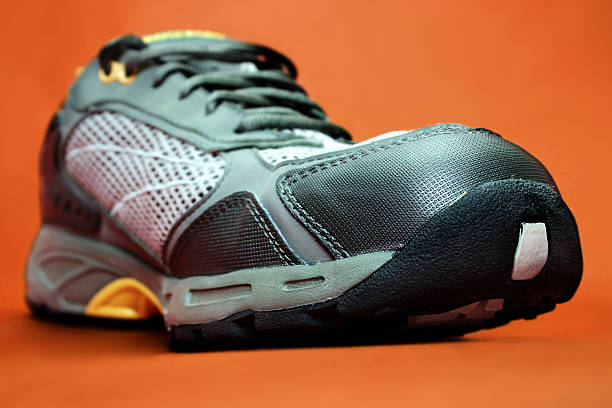
Breathability provides another revealing contrast. Engineered knits are praised for airflow, yet the reality is more nuanced. The open loops of a knit allow large volumes of air to pass through quickly, which feels cooling on a still day. However, once the foot begins to sweat, those same loops can become saturated with moisture that wicks poorly across hydrophobic synthetic fibers. Nylon mesh, especially when constructed with a dual-layer sandwich (a coarse outer hexagon bonded to a finer inner honeycomb), creates capillary channels that pull sweat laterally and allow it to evaporate from a larger surface area. This is why many old-school soccer cleats and tennis shoes used mesh panels that remained dry to the touch even after hours of play. The mesh’s openness is not just about holes; it is about the orientation of those holes relative to the foot’s moisture profile.
Structural support is where traditional mesh truly separates itself from knit. A knit upper relies heavily on its own tension and external overlays to prevent the foot from rolling over the midsole during lateral cuts. Manufacturers often add fused TPU films or internal cages to compensate, which adds weight and can create hot spots. Nylon mesh, especially when bonded to a thin foam layer, offers a more rigid substrate that resists stretch in all directions. This is critical for basketball and high-intensity interval training, where sudden directional changes demand that the upper does not deform under load. The Jordan Why Not series and the Nike Zoom Vaporfly have, at various points, reintroduced mesh elements precisely because knit could not handle the torque generated by elite athletes.
Weight is the one area where knit undeniably wins. A knit upper can shave 30 to 50 grams off a shoe compared to a mesh-and-leather hybrid. For a marathon runner seeking to shave seconds per mile, that reduction matters. Yet for most recreational athletes, the trade-off in durability is not worth the marginal weight savings. Moreover, recent developments in hybrid mesh—combining recycled polyester filaments in a tighter weave with strategic laser-cut perforations—have closed the gap. Brands like New Balance and ASICS have released performance shoes using these advanced meshes that weigh only slightly more than their knit counterparts but offer twice the abrasion resistance.
Environmental considerations also tilt the scale toward mesh. Engineered knits often combine multiple yarn types—nylon, polyester, elastane—that are difficult to separate at end of life. Traditional nylon mesh, if made from a single polymer, can be mechanically recycled into new fibers. The simplicity of mesh construction also requires less energy to produce, as it does not demand the complex jacquard knitting machines that run for hours to create a single knit pattern.
Ultimately, the choice between knit and mesh is not a straight-line progression of technology replacing an inferior predecessor. It is a pendulum that swings based on the specific demands of a given sport. For casual comfort and lifestyle wear, the plush, sock-like feel of engineered knit is unmatched. But for performance testing that involves cutting, sliding, mud, and repeated high-impact lateral motion, traditional nylon mesh—especially when reinforced with thoughtful overlays—remains the more intelligent, longer-lasting material. The sneaker world would do well to remember that innovation does not always mean abandoning the proven.
Articles