
The Minimalist Blueprint: How the Chuck Taylor All Star’s Canvas Construction Defined an Era of Sneaker Design
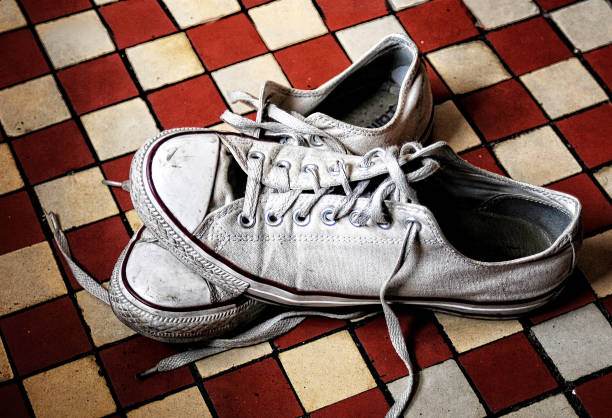
The Converse Chuck Taylor All Star, for all its cultural ubiquity, began as a solution to a remarkably specific problem: basketball players in the early twentieth century needed a shoe that was lighter and more flexible than the heavy, hobnailed leather boots then worn for indoor court sports. The original design, a high-top canvas sneaker with a rubber sole, was not the result of any grand aesthetic ambition. It was an exercise in brutal functionalism. Yet that very functionalism—the stripped-down, unadorned simplicity of canvas and rubber—became the most influential template in sneaker design history, teaching generations of manufacturers and consumers that a shoe does not need technological gimmicks or elaborate ornamentation to achieve iconic status.
The construction of the original Chuck Taylor was almost painfully straightforward. A cotton canvas upper provided breathability and lightness, while a vulcanized rubber outsole delivered grip on wooden floors without the weight of leather. The distinctive toe cap, a separate rubber piece covering the front of the shoe, was not a style statement but a necessary reinforcement against the scuffs and abrasions of pivoting and stopping. The circular patch on the ankle—the now-iconic all-star logo—originally served as a reinforcement for the lace eyelets. Every element had a purpose. And that lesson—that purpose can generate beauty—reverberated through the following century of sneaker design.
When the shoe transitioned from an athletic necessity to a lifestyle staple, its minimalism became its greatest asset. Unlike heavily branded or technologically complex sneakers, the Chuck Taylor presented a neutral palette, a blank canvas that invited personal interpretation. Artists painted on them. Musicians scuffed them. Skaters wore them ragged. The shoe’s refusal to shout allowed wearers to project their own identities onto it. This quality directly inspired later minimalist movements in sneaker design, from the understated lines of the Adidas Stan Smith to the Scandinavian simplicity of Common Projects. Those later sneakers are often described as “elevated” versions of canvas basics, but their DNA is unmistakably Chuck Taylor: a simple profile, minimal branding, and a reliance on material quality rather than flash.
The vulcanization process that gave the Chuck Taylor its durability also established a manufacturing standard. Vulcanized rubber—rubber cured with heat and sulfur to create a strong, flexible bond—became the default for countless sneaker brands. Vans borrowed the technique for its Authentic model. Puma used it for its early suede sneakers. Even modern performance basketball shoes occasionally nod to the process in their outsole construction. The Chuck Taylor did not invent vulcanization, but it popularized it so thoroughly that the method became synonymous with casual sneakers. A century later, the same rubber recipe, barely altered, still rolls off production lines.
The Chuck Taylor’s influence extended beyond materials into silhouette and proportion. The high-top cut, with its ankle collar and padded tongue, set a standard for basketball shoes that lasted until the 1980s. When Nike and Adidas began experimenting with foam, air cushions, and synthetic uppers, they did so on a template that the Chuck Taylor had defined: a shoe that rises above the ankle, laces symmetrically, and protects the foot without restricting movement. Even the low-top version, introduced in the 1960s, predated and influenced the rise of casual court sneakers like the Nike Cortez and the Adidas Gazelle.
In the world of fashion, the Chuck Taylor’s minimalism allowed it to transcend subcultures. It was equally at home in a punk mosh pit, a 1990s hip-hop video, a suburban skatepark, and a Paris runway. This adaptability forced designers to reconsider the relationship between sneakers and style. The shoe proved that a sneaker did not need to be new to be relevant; it needed to be simple enough to be reinterpreted. High-fashion collaborations with Comme des Garçons, Off-White, and Maison Margiela have repeatedly returned to the Chuck Taylor model, not because they want a vintage basketball shoe, but because the canvas base is the perfect framework for deconstruction, patching, and reimagining.
The lesson of the Chuck Taylor All Star is that the most enduring designs are often the most restrained. A century of sneaker evolution—from air bubbles to knit uppers to self-lacing mechanisms—has produced marvels of engineering, yet none have displaced the canvas-and-rubber original. Its construction remains unchanged because it was right from the start: lightweight, durable, and honest. Every element that made the shoe functional in 1917 made it timeless in 2024. The Chuck Taylor did not merely survive the hundred-year journey from basketball court to global icon. It taught the entire sneaker industry that greatness does not require complexity, only clarity of purpose.
Articles