Why the Converse Chuck Taylor All Star Remains a Canvas for Personal Expression

The Converse Chuck Taylor All Star has spent more than a century proving that simplicity can be radical. Born as a canvas-and-rubber basketball shoe, it was never designed to be precious. Its plain upper, flexible sole, and modest silhouette made it useful first and stylish second. That utility became the foundation for something larger: a shoe that could absorb whatever its wearer brought to it. In an era when sneakers are often engineered as statements, the Chuck Taylor endures because it remains a canvas. It does not demand attention with complex branding or futuristic materials. Instead, it invites alteration, interpretation, and ownership.
The shoe’s earliest identity was athletic. Chuck Taylor, a basketball player and salesman, helped refine and promote the design in the early twentieth century, turning a practical court shoe into a recognizable name. For decades, the All Star was associated with gym floors, school teams, and the growing culture of American basketball. Yet even then, its look was sparse. The toe cap, ankle patch, and rubber stripe were details rather than decoration. That restraint meant the shoe could leave the court without looking out of place. When athletes retired their pairs or kids inherited them, the Chuck Taylor slipped easily into everyday life.
Music turned that everyday shoe into a symbol. In the 1970s and 1980s, punk and post-punk musicians adopted the Chuck Taylor as a uniform of sorts. Scuffed canvas and worn rubber suggested immediacy, rebellion, and DIY ethics. The shoe was affordable, available, and easy to mark up with paint, laces, or handwritten slogans. Bands who rejected polished aesthetics found a natural ally in a sneaker that looked better with wear. The same qualities appealed to skaters, who valued the flat sole and grip before technical skate shoes existed. The Chuck Taylor became a tool for movement and a surface for self-definition.
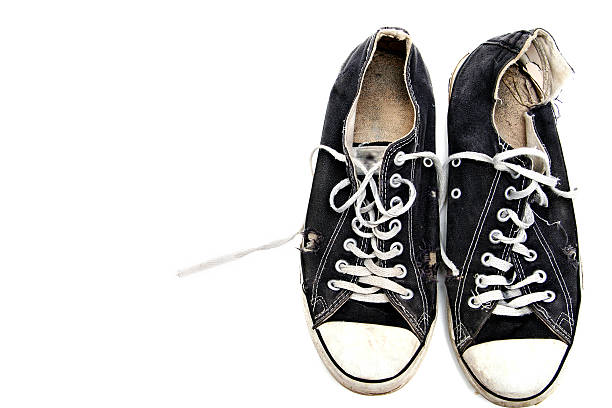
Customization is where the shoe’s legacy becomes most personal. A plain white pair can become a sketchbook. A black high-top can carry band names, political statements, love notes, or city maps. Eyelets can hold mismatched laces; rubber toe caps can be painted, sanded, or left to yellow. The Chuck Taylor’s large canvas panels and simple construction make it unusually receptive to modification. Artists have embroidered it, screen-printed it, studded it, and cut it apart. Designers have reinterpreted it in leather, velvet, and recycled materials, but the original form remains recognizable. That recognizability gives customization meaning: the shoe is still a Chuck, even when it is entirely the wearer’s own.
The All Star also carries a strong sense of memory. Many people remember a first pair, a school uniform, a concert, a summer job, or a friend’s handwriting across a toe cap. Because the shoe ages visibly, it records time. Creases, scuffs, and faded rubber become evidence of use rather than defects. In a sneaker landscape that often prizes pristine condition, the Chuck Taylor offers a different value: character. Its imperfections are part of its appeal, and its low cost has historically made experimentation less intimidating. Wearers can personalize a pair without treating it as a museum object.
Fashion has repeatedly returned to the Chuck Taylor for the same reasons. Its shape is familiar enough to anchor almost any outfit, yet neutral enough to disappear into a personal look. It has appeared in grunge, minimalism, prep, streetwear, and high fashion without losing its identity. Collaborations and limited editions add novelty, but the core shoe remains modest. That balance between consistency and adaptability is rare. The Chuck Taylor is not timeless because it never changes; it is timeless because it can change without breaking.
Ultimately, the Converse Chuck Taylor All Star remains a canvas for personal expression because it trusts the wearer. It offers structure, history, and recognition, then leaves the rest open. In doing so, it turns a mass-produced sneaker into something individual. A century after it first rolled onto a basketball court, the shoe still works the same way: plain enough to begin again, iconic enough to be recognized, and open enough to become whatever the person wearing it needs it to be.